Hydraulic Filter Placement
Choosing The Perfect Filter Placement in Hydraulic Systems
The positioning of the filters in your equipment or your hydraulic system determines how well the pressure and contaminants are regulated. Some filter placements such as the return filtration seem so perfect but can cause negative effects at times.
Proper filter placement is always something to be aware of. Because as a professional who knows his work well, improper filter alignment can be the beginning of very severe system failure. Join us as we examine some of the most common filter placements so you might know which positioning works best for your hydraulic system.
Return Oil filtration
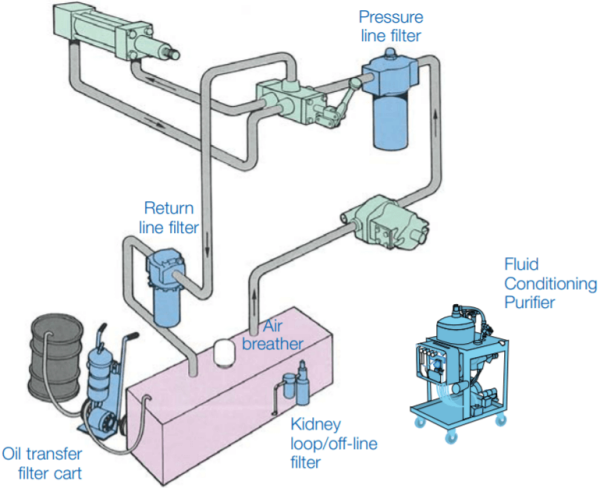
The baseline for this filter placement is keeping the reservoir clean at all times. Here, every ounce of air and oil entering the reservoir is filtered. It thus goes without saying that the levels of impurities entering the hydraulic reservoir are kept at the minimum point.
Among its key advantages is pressure regulation. It allows just enough pressure to force hydraulic fluid through media as small as 10 microns in size. The pressure is low enough to not cause housing or filter design complications. Again, it produces a high filtration degree. It creates a low flow velocity that allows sufficient sieving of the fluid passing through.
The main reason why you’d want to keep away from this type of filter placement is the back pressure it generates. This pressure can damage other components or even worse, retard the hydraulic system functionality.
Suction Filter Placement
Placing a filter at the pump’s intake can help improve the filtration efficiency. This position has controlled fluid velocity and pressure. This means that the trapped particulates can remain undisturbed on the filters.
With its big disadvantages, you might really want to be careful on this filter positioning. For one, it generates a big deal of restriction at the pump’s intake. If you are a professional in hydraulics, you know this brings cavitation erosion and other mechanical damages.
But if you have to use it, consider one that is 50-150 micros in size with a low pressure drop.
Pressure Filter Placement
These are located just down from the pump. And just like their name suggests, they control the pressure down there, not to mention any contamination generated from the pump. Their placement suits them as the perfect protectors of hydraulic components that are right downstream from the filter.
You can’t avoid these, can you? The housing and elements have to withstand the maximum pressure generated by the hydraulic system. So there must be pressure filters. The only issue with them is that their price is high. But without them, the liabilities would be much worse.
Off-line Filtration
This is also called the kidney loop, auxiliary filtration, or recirculating. It involves an independent system that pumps oil from the reservoir, through the filter and then back to the reservoir again in a continuous flow. With this continuous flow fashion, this filtration method keeps contamination levels at the low end at all times.
A Tip From An Experienced Hand
Before adding a filter in your hydraulic system, you should consider your machine thoroughly, think through the options and possibilities to find the best fit, if you want make sure you are going to to place the filters in the right place and proper direction, you should consult the manufacturer’s manuals.
Whichever filter you use, just make sure that it keeps contaminants away from the hydraulic system.
Are you considering adding some more filters in your plant, equipment or hydraulic system and you are not sure of how to go about it?