Hydraulic Valves for Beginners
The first thing you need to know about hydraulic valves is that they are different, each plays a specific role.
The second thing is that a valve can be installed anywhere (within the designated areas) to fill a role-gap. For instance, when you are troubled by irregular fluid flow in the hydraulic system, fitting a flow valve somewhere in the hose can help the situation. All in all, the rule of thumb still stands; don’t use a hydraulic valve where it shouldn’t be used.
In this article, we will look into the several types of valves and their applications. This will help you make the perfect decision for your valve needs.
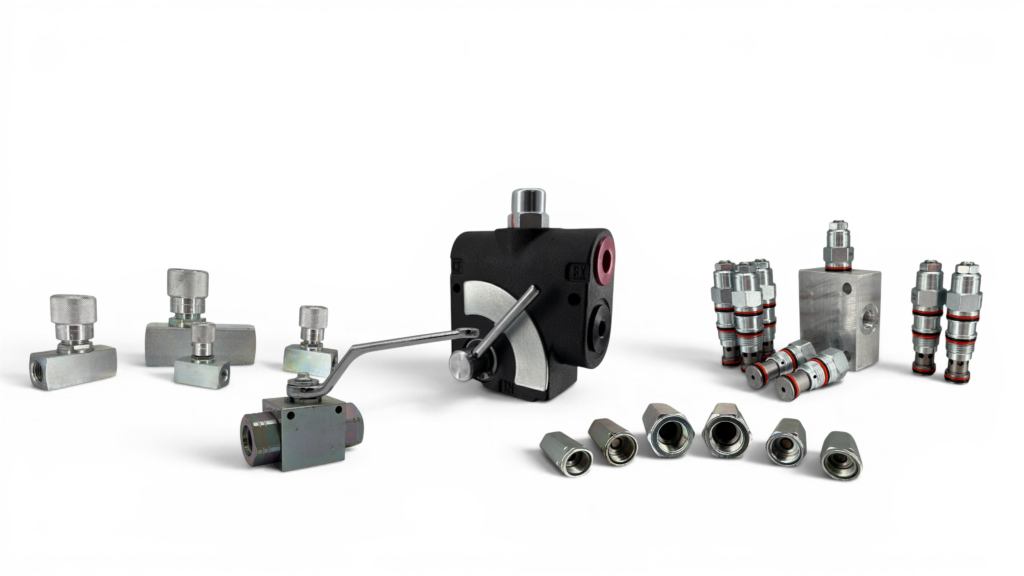
Flow control valves
Just like their name suggests, these valves control the flow of the hydraulic fluid. As simple as that. But they take different forms.
Reverse flow check– This helps regulate the hydraulic fluid flow when lifting the load and during lowering. They allow a full flow in the out direction via an inbuilt check valve. During lowering, the full-flow path is checked to force the fluid to pass through the flow restriction. Through this, cylinders are able to descend controllably.
A fixed orifice– This is typically a hole in the hose to restrict the amount of hydraulic fluid passing through at a particular pressure. It can also be an insertion that fits in the hose.
An adjustable orifice– In these, the size of the insertion can be adjusted to fit the desired measurements. They are mainly used in machines that have a uniform load such as tippers and lifts.
Pressure compensating– Pressure changes during operations can cause adverse effects not only to the hydraulic system but also to the load and the whole equipment in general. Pressure compensating valves can save the situation. Well, how is that? By accounting for the pressure changes to deliver a uniform fluid flow all through.
Relief valve
When the pressure goes overboard, it is the role of relief valves to regulate it and get the equipment back to normality. How does it do this? Well, most relief valves have a spring and a plunger pushing against a seat. If (by any chance) the hydraulic pressure beats the spring force, some fluid is spilled (usually into the reservoir). And eventually, the excess pressure drops.
You might be wondering where to locate the relief valves. It’s easy. Because high-pressure areas will definitely need one. Better still, you can protect the pump by installing a relief valve at the power pack. Also, consider fixing another on the control valve circuit.
Dual flow control valve
Now, this comprises of two valves in one set. Yes, two in one. And just like the name suggests, they control hydraulic fluid flows originating from two directions. They permit a full flow in one direction and control the flow from the other direction. Through this, they achieve in heightening the actuator speeds.
Check valves
All they do is prevent reverse flow (the backward flow). As you can already figure out, a reverse flow can empty the hydraulic fluid (all of it) from the hydraulic system into the reservoir. This is terrible because there won’t be any fluid to start the system the next time it’s needed.
Typically, (or always) they have two ports. One is the inlet while the other is obviously the outlet. They sound so simple, isn’t it? Well, maybe it’s true, but they might be the only thing standing between your plant’s optimal productivity and a year-long downtime.
Originality matters
I’ve always insisted on the originality of every component. And those who have heeded my word have seen the positive side of it. You want a product that you can always reach out to the manufacturer if it malfunctions. You don’t need a component that you will have to throw away if it doesn’t fit in your hydraulic system. You deserve better guarantee for your money.
Now, if you want to get all of these benefits and many more, BJ Hydraulic is the place to be. We supply unique hydraulic products. And by the way, our designs are awesomely awesome. We always aim to be one step ahead when it comes to innovation.
.